

Start with a curriculum; the other filters appear as you choose.

Quantum physics

Question Bank · IBDP › Physics › E. Nuclear and quantum physics › Quantum physics

[5]
Question
Concept notes for this question · Quantum physics · 4 cards

Photoelectric effect

State Einstein's photoelectric equation and the key observations.

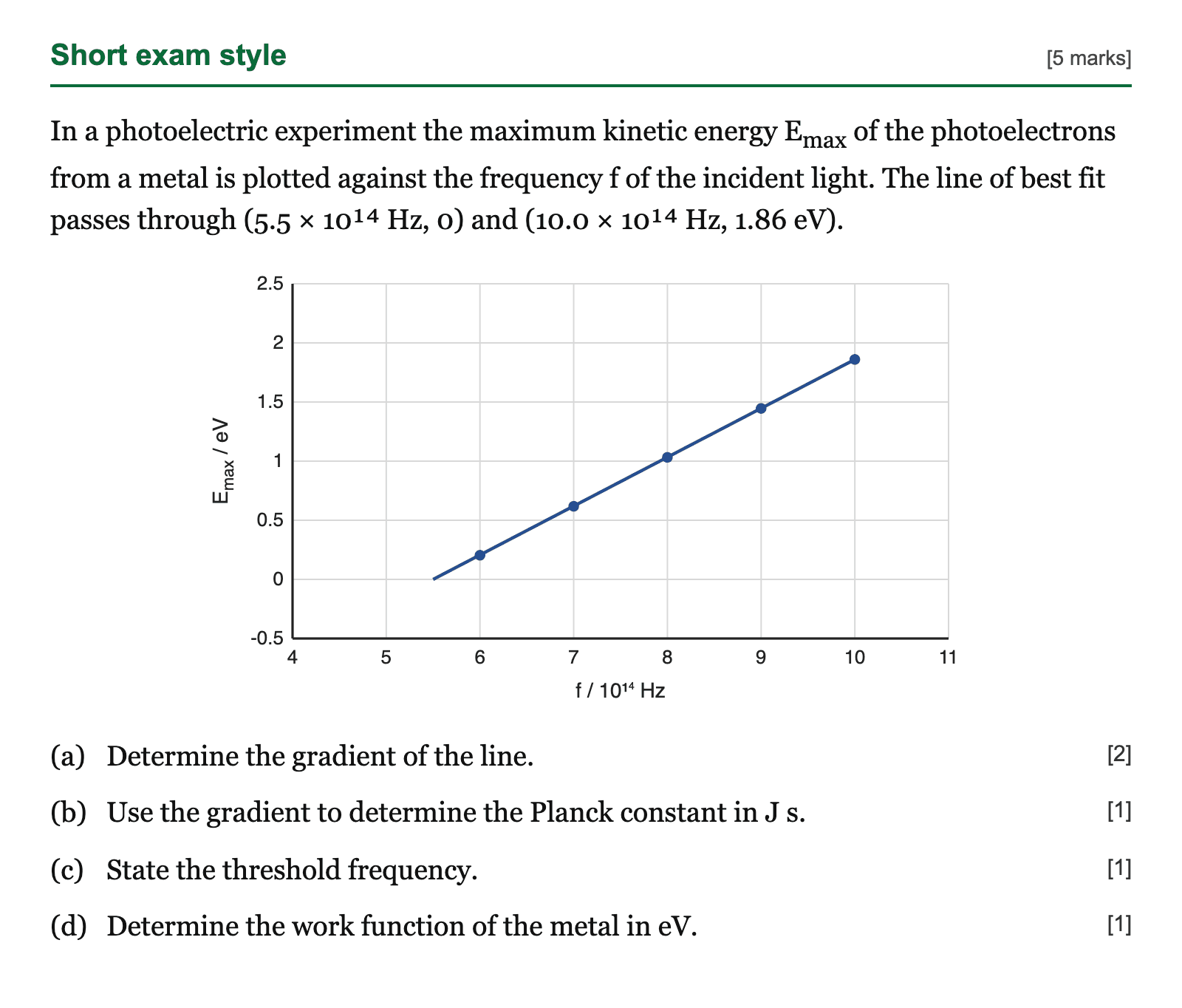
EK,max=hf−Φ,hf0=ΦE_{K,max} = hf - \Phi,\quad hf_0 = \Phi
  • No emission below the threshold frequency, however intense the light.
  • Emission is instant; more intensity gives more electrons, not higher energy.
  • Stopping potential: eVs=EK,maxeV_s = E_{K,max}.

Watch out: A gradient of EKE_K against ff gives hh; the intercept on the energy axis is −Φ-\Phi.

Wave–particle duality

What is the de Broglie wavelength?

λ=hp=hmv\lambda = \frac{h}{p} = \frac{h}{mv}
  • Electron diffraction shows particles behave like waves.
  • A photon has momentum p=h/λp = h/\lambda.

Heisenberg uncertainty principle

What does the uncertainty principle limit?

Δx Δp≥h4π,ΔE Δt≥h4π\Delta x\,\Delta p \ge \frac{h}{4\pi},\quad \Delta E\,\Delta t \ge \frac{h}{4\pi}
  • It is a limit of nature, not of the instrument.

Wavefunction and tunnelling

What does the wavefunction tell us?

P∝∣ψ∣2P \propto |\psi|^{2}
  • ∣ψ∣2|\psi|^{2} gives the probability density of finding the particle.
  • A particle can tunnel through a barrier; the probability falls with barrier width and height.

Revise this topic as flash cards →

Log in to save progress and marks.

Keys: ← → next / previous question · M question / mark scheme